There are several navigation and charting sources available online that are potentially very useful for the Great Lakes sailor. The following is listing of some that we have found the most useful for planning a cruise in the Great Lakes.
1) OpenCPN - Awesome free software to convert your laptop into a GPS chartplotter.
2) Printable NOAA Charts - Great for desktop cruising, planning and some printing.
3) NOAA BookletCharts - Excellent for printing your own charts in 8.5" x 11" booklet format.
4) Lake Michigan Waypoints - Perfect for updating your GPS with common waypoints while at home.
5) GoSail.com - Nice, simple website with Lake Michigan specific information
6) Great Lakes Information Network - Tons of information, maps and tools specific to the Great Lakes.
There are of course many, many more sites that are also useful. For instance, Google Earth is an amazing tool for getting a bird's eye view of your sailing area. If you know of other sites that our readers may find useful, please contact us!


Weather for Great Lakes Sailing

Having access to good, reliable weather reports is critical for any serious Great Lakes sailing. If you're planning a cruise or preparing for a race, you'll need to track the wind, temperatures, precipitation, waves and any number of other variables. We've compiled the list of website links below as a tool for Great Lakes sailors to use. You will also notice that we've added a sidebar with the same Great Lakes weather links so that you'll also have access from the Great Lakes Sailing homepage.
Here are the Great Lakes weather links:
NOAA's Great Lakes Weather Map: A great tool for visually viewing current and forecasted data on wave height, wave period, wind speed, wind gusts, weather and temperature.
Wunderground Marine Forecast: A textual summary of current and forecasted marine weather for the Great Lakes.
National Weather Service Marine Forecasts: Great tool for quickly locating your local NWS marine forecast, regardless of where you are on the Great Lakes.
National Buoy Data Center: Easy access to all the data from Great Lakes buoys including wave height, wind speed and water temperature.
SailFlow: Very powerful tool that integrates wind data with marine forecasts for specific areas within the Great Lakes.
Product Review: Tiller Tamer from Davis Marine
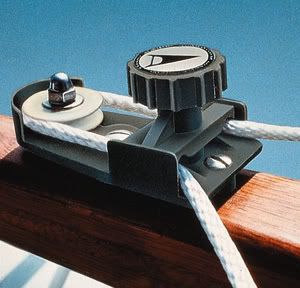 Have you ever been out for a lazy Great Lakes sail and wished you could step below for moment to grab a cold drink or perhaps a pair of sunglasses but you couldn't leave the tiller unattended? Davis Marine makes a product they call a "Tiller Tamer" that might help in such a situation.
The Tiller Tamer is essentially a clamping device for a tiller control line. It is constructed of durable, hard plastic with stainless steel hardware (screw/hex nut). The Tiller Tamer mounts directly on top of the forward end of the tiller handle. If your tiller is made of anything other than wood, you may need to fabricate mounting hardware or forego the Tiller Tamer all together. The device is mounted via two wood screws. The control line (1/4" diameter provided) is then run from the stern corners of the cockpit to the Tiller Tamer. I personally use jam cleats mounted directly in the fiberglass of the cockpit's stern to anchor the control line. You could also use cam cleats or other means. The Tiller Tamer does NOT come with any cleats.
The device works by turning the knob on top of the Tiller Tamer to essentially clamp the control line and thereby hold the tiller in a set position. I've found the clamp to hold very well in most conditions. Davis Marine advertises that the device works in "any weather or wind condition", but I wouldn't trust it in anything more than moderate wind and waves. I also would not recommend leaving the cockpit or tiller completely unattended while the Tiller Tamer is in use. Depending on how well your boat tracks, you may find that even with the Tiller Tamer in use the boat will wander and move off course in a matter of minutes. Small adjustments and a watchful eye make the Tiller Tamer more effective.
If you're looking for a simple and affordable way to occasionally free up your hands while in the cockpit, the Tiller Tamer should do the trick. However, I do not recommend it as a method of true self-steering. The Tiller Tamer can be purchased from many vendors from between $25 and $35, plus the cost of cleats.

Winter's halftime in the Great Lakes

Are we halfway through another winter in the Great Lakes? Close enough by my calendar. As February quickly approaches, spring task lists start to float to the top of a sailor’s brain. I’m sitting here in my office daydreaming about oiling teak handrails, applying bottom paint to my hull, cleaning my sails and a dozen other activities that would seem like chores were it any other time of year. The middle of winter has a strange way of making me appreciate summer. To paraphrase John Denver’s “Relatively Speaking”: The sunshine needs the shadows of the night. Contrast makes it go. And so, summer needs the depth of winter.
Re-bedding Deck Hardware
After purchasing my long-neglected 1972 Helms 25 earlier this summer, the first project I undertook was re-bedding the deck hardware to fix water leaks in the cabin, improve safety (lifeline stanchions, chainplates, etc.) and prevent water leaks into the balsa core of the boat’s deck.
I started with a couple of pieces of deck hardware that I know currently leak (2 stanchions, 2 chainplates). After loosening the through-bolts, I carefully pried the hardware off of the deck. Patience is required because the original epoxy and/or sealer used with the hardware can still be holding fast to the deck in some places. If you pull or pry to aggressively you risk damaging the gelcoat and fiberglass on the deck.
After the hardware was removed from the deck, I cleaned the bedding area and hardware bases with a wire brush and acetone. The acetone does a nice job of removing the old epoxy, but be sure to wear rubber or latex gloves. The chainplates had steel backing plates under the deck that were re-usable after they were cleaned. The lifeline stanchions were backed with plywood that was completely rotted. I replaced the rotted backing with new marine plywood backing, using the old pieces for templates.
I then used two-part marine epoxy (PC Products PC-11 Marine Epoxy Paste) to seal and bond the hardware bases with the fiberglass deck. Per Don Casey's (author, This Old Boat) recommendation, I did not seal the hardware on the underside of the deck around the backing plates so that future leaks are visible and can be fixed before they contribute to a deck rot problem.
I carefully re-mounted and re-tightened (over a matter of hours) the hardware and then trimmed away the epoxy that seeped out after it had cured. Using masking tape on the deck around the edges of the hardware saved a big mess of overflowing epoxy. When re-mounting the hardware, you may consider using larger diameter washers. I considered the original washers on my boat too small to provide the amount of support required by most deck hardware applications.
As long as your boat doesn’t need new hardware, the costs associated with re-bedding deck hardware are basically limited to purchasing acetone and epoxy. The most difficult aspect of the project is often gaining adequate access to the underside of the hardware. Re-bedding deck hardware is a project that most of us should be capable of undertaking. I’m willing to bet that most good old boats would benefit greatly.
I started with a couple of pieces of deck hardware that I know currently leak (2 stanchions, 2 chainplates). After loosening the through-bolts, I carefully pried the hardware off of the deck. Patience is required because the original epoxy and/or sealer used with the hardware can still be holding fast to the deck in some places. If you pull or pry to aggressively you risk damaging the gelcoat and fiberglass on the deck.
After the hardware was removed from the deck, I cleaned the bedding area and hardware bases with a wire brush and acetone. The acetone does a nice job of removing the old epoxy, but be sure to wear rubber or latex gloves. The chainplates had steel backing plates under the deck that were re-usable after they were cleaned. The lifeline stanchions were backed with plywood that was completely rotted. I replaced the rotted backing with new marine plywood backing, using the old pieces for templates.
I then used two-part marine epoxy (PC Products PC-11 Marine Epoxy Paste) to seal and bond the hardware bases with the fiberglass deck. Per Don Casey's (author, This Old Boat) recommendation, I did not seal the hardware on the underside of the deck around the backing plates so that future leaks are visible and can be fixed before they contribute to a deck rot problem.
I carefully re-mounted and re-tightened (over a matter of hours) the hardware and then trimmed away the epoxy that seeped out after it had cured. Using masking tape on the deck around the edges of the hardware saved a big mess of overflowing epoxy. When re-mounting the hardware, you may consider using larger diameter washers. I considered the original washers on my boat too small to provide the amount of support required by most deck hardware applications.
As long as your boat doesn’t need new hardware, the costs associated with re-bedding deck hardware are basically limited to purchasing acetone and epoxy. The most difficult aspect of the project is often gaining adequate access to the underside of the hardware. Re-bedding deck hardware is a project that most of us should be capable of undertaking. I’m willing to bet that most good old boats would benefit greatly.
A Sailor's Christmas
Being that the Christmas season is upon us and the very day is just around the corner, I thought I'd share the wonderful lyrics of one of my favorite sailing songs and favorite Christmas songs. One line in particular seems particularly appropriate for this very snowy winter in the Great Lakes: "But Christmas is the season better suited for dry land..."
Enjoy!
A Sailor's Christmas
(Jimmy Buffett, Roger Guth)
A sail on the horizon's got a land fall rendezvous
The captain steers a well known course he steers her straight and true
As he trims the sheets he sings a song he learned on boats and bars
"A sailor spends his Christmas in a harbour 'neath the stars"
He's traveled through the doldrums, typhoons and hurricanes
He's logged a million soggy miles, with water on his brain
But Christmas is the season better suited for dry land
He'll tell some lies, meet some spies and dance barefoot in the sand
Chorus:
A sailor spends his Christmas in a harbour on the hook
Cali, Calais no work today, let's shelve the old log book
The waterfront is reveling, the season has begun
A sailor spends his Christmas in a harbour having fun.
There's a party down at Le Select all music, rhum and cheers
Faces in the shadows, I haven't seen for years
The masts and shrouds are filled with lights 'neath the waning of the moon
There's an air of celebration in the realm of King Neptune.
Chorus:
A sailor spends his Christmas in a harbour on the hook
Cali, Calais no work today, let's shelve the old log book
The waterfront is reveling, the season has begun
A sailor spends his Christmas in a harbour having fun.
Jesus was a fisherman who walked upon the sea
The North Pole is the ocean's remote frozen balcony
The continents keep drifting but the children sing and play
Cause nothing really matters after all it's Christmas day
Enjoy!
A Sailor's Christmas
(Jimmy Buffett, Roger Guth)
A sail on the horizon's got a land fall rendezvous
The captain steers a well known course he steers her straight and true
As he trims the sheets he sings a song he learned on boats and bars
"A sailor spends his Christmas in a harbour 'neath the stars"
He's traveled through the doldrums, typhoons and hurricanes
He's logged a million soggy miles, with water on his brain
But Christmas is the season better suited for dry land
He'll tell some lies, meet some spies and dance barefoot in the sand
Chorus:
A sailor spends his Christmas in a harbour on the hook
Cali, Calais no work today, let's shelve the old log book
The waterfront is reveling, the season has begun
A sailor spends his Christmas in a harbour having fun.
There's a party down at Le Select all music, rhum and cheers
Faces in the shadows, I haven't seen for years
The masts and shrouds are filled with lights 'neath the waning of the moon
There's an air of celebration in the realm of King Neptune.
Chorus:
A sailor spends his Christmas in a harbour on the hook
Cali, Calais no work today, let's shelve the old log book
The waterfront is reveling, the season has begun
A sailor spends his Christmas in a harbour having fun.
Jesus was a fisherman who walked upon the sea
The North Pole is the ocean's remote frozen balcony
The continents keep drifting but the children sing and play
Cause nothing really matters after all it's Christmas day
Painting a Sailboat Bilge
 A clean, well-kept bilge says a lot about a boat's overall condition in my book. Clean bilges let you know that the ship's captain doesn't live by the philosophy of "Out of sight, out of mind". Sure, bilges inherently get dirty and wet quickly and easily. But if you start with a good foundation, they are easier to keep clean and much more hospitable during those claustrophobic moments when you have to cram yourself deep into the bowels of the vessel for maintenance and repair.
I began restoring our boat's (1972 Helms 25 Hull #44) bilge by first removing any debris and lost hardware that had fallen in over the years. Then I scrubbed mightily with a solution of Comet, bleach and warm water. This removed most of the mildew, stains and dirt that had built up during the years since 1972. Next, I used my ShopVac to suck up residue left from the Comet, small particles of dirt and sand, and make certain the entire bilge was dry. Lastly, I used a 220 grit sanding sponge to finish surface preparations. The ShopVac was used again to vacuum up the dust from sanding. Luckily, about 99% of the bilge is fairly accessible on a Helms 25.
When the bilge was cleaned out, I applied two coats of durable, latex garage floor paint. I'm told International makes a great bilge paint product called "Danboline", but I'm on a tight budget for this project so I went with some leftover floor paint that I had used in my basement and garage earlier in the year. The paint went on surprisingly well for such a dingy, dirty application. I simply cut-in using a good quality brush for latex paints and then rolled on two coats of the paint with a 3/8” nap roller cover designed for semi-smooth surfaces.
 Depending on the size of your boat and the condition and access to your boat’s bilge, this project should be easy to complete within a day or two for even novice painters. The cost is almost solely dependent upon the amount of paint need to sufficiently coat your bilge. While most passengers and guests (let alone crew!) will probably not even notice how beautiful my bilge and storage areas have become, I'll stand with my chin just a bit higher knowing that even the out-of-sight areas of my Helms 25 received TLC!
Bonus content: Here's some of the latest YouTube sailing videos:
Subscribe to:
Posts (Atom)