The Best Sailing and Boating Apps

I've often said that one of my favorite aspects of sailing is the ease at which you can unplug yourself from the complexities and over abundance of technologies. However, I'm also a bit of a gadget junkie and have become very fond of my iPad, even while on the boat. What follows is a list of my favorite apps for sailing. All are available in Apple's app store (and likely in the Android market too) and work on both an iPad and iPhone.

1) Navionics HD: While expensive compared to most apps, Navionics HD is an outright bargain when compared to tradition chartplotters. The bathymetric charts are beautifully detailed and include the option of overlaying Google Earth, Bing aerial photos or topographic terrain maps for land. Functions include tracks, route planning and guidance, speed data and many other goodies you would expect from a gps plotter.


2) Sail Master: This is a simple app, but it looks and works great. Think of Sail Master as your digital instrument panel. The app shows boat speed, boat position (lat & long), and heading. As a bonus, there's also an inclinometer to see your angle of heel. Each instrument can be shown onscreen individually or in a nice combo screen showing all data. The teak and brass look of the instruments really makes the aesthetics pop.


3) Ship Finder HD: If you don't have AIS on your boat, Ship Finder brings the data to a screen near you...sort of. You can't transmit your position with the app, but any commercial or recreational vessel that's transmitting can be displayed on your screen. You'll get the usual AIS data such as vessel destination, course, speed, length, etc. This probably shouldn't be relied upon for navigation and traffic avoidance, but it's a fun tool.


4) Wind Meter: Here's your anemometer for the iPhone. This isn't quite as accurate as a handheld Windmate or your masthead anemometer, but it's a cheap, simple app that gives wind data good enough to be useful. I love the ingenuity of using the wind noise coming through the iPhone microphone combined with algorithms to spit out an approximate wind speed.


5) Compass HD: This is as simple as it sounds - just a nautical-looking and functional compass for your idevice.


6) MyRadar: There are many good weather apps available and most include weather radar. However, not many are as simple, reliable and quick as MyRadar if all you're concerned with is seeing what storms are headed your way.


7) Cruising World: iPads are excellent for viewing magazine a content and Cruising World magazine is the first (far as I can tell) sailing mag to publish issues digitally for IOS devices.


-Posted using BlogPress from my iPad

Book Review: The Modern Cruising Sailboat by Charles Doane

Book Review
The Modern Cruising Sailboat: A Complete Guide to its Design, Construction, and Outfitting


Winter is the time for Great Lakes sailors who haven’t pointed the bow south towards little latitudes to plan next season’s cruises, prepare the spring maintenance list, shop for boat upgrades, learn more about sailing and dream about their “next boat”. Books provide a great means for beginning all of these processes.

The Modern Cruising Sailboat (International Marine 2009) by Charles Doane offers a wealth of information useful as a guide for beginning cruising sailors and as an authoritative and nearly comprehensive review for cruising veterans. While mostly directed at the cruising sailor, racers and day sailors will also likely find the book interesting.

The book is well written with great illustrations and pictures. The first half of the book covers design and construction and is the most comprehensive at doing so that I’ve read in a book aimed at a cruising audience. There’s also a fair bit of historical information that some readers will enjoy. While readers likely won’t find all of the information and ideas for fitting out a cruising boat new, I’m certain they will pick up several ideas that will be helpful.

There's also a section at the end where Doane reviews 40 cruising boats ranging from 27' to ~60' feet. He chooses boats that he recommends for cruising based on his personal experience and gives a wide-array of different styles. This is the section of the book that many readers will gravitate towards for practical perspective on which boats to consider for purchase and which boats to keep locked in their minds as dream boats. I personally appreciated the size range, price range and collections of older boats included in the this section. Doane certainly could have included many new boats with his experience as editor-at-large for Sail magazine, but instead I believe he appeals to a wider audience by including several vintage, “affordable” cruising sailboats. While I would have liked to see a review of at least one pilothouse or motor-sailer, Doane candidly told me in an email correspondence that he’d like to add these if a second edition of the book is published.

While I’ve read just about all the sailing books and magazines I can get my hands on, The Modern Cruising Sailboat is the type of book I’ll keep close at hand for reference, alongside a select few other titles such as Beth Leonard’s The Voyager’s Handbook and Don Casey’s This Old Boat. Unfortunately I enjoyed Doane’s book so much that I read through it in about a week’s time so now I’ve got to find more reading to take me through the rest of the long Great Lakes winter.

The Modern Cruising Sailboat is readily available on Amazon.com.  You can read more about the author on his personal blog at http://www.wavetrain.net/

All hands...er, fingers on deck! Vibram Five Fingers Review

Gear Review: Vibram FiveFingers for Sailing/Deck Shoes

Deck shoes seem to be a very personal matter to most sailors. Some swear by Sperry’s TopSiders or Sebago’s Docksider line. Racing sailors often seem to prefer a more snugly fitting athletic shoe with a sole specialized for the deck, such as those offered by Harken. I’ve always been much more casual with my choice of footwear for the boat. Typically you can find me in flip-flops, Crocs or often barefoot while sailing. Crocs provide a bit of protection from stubbing a toe on deck hardware and have a decent amount of grip in wet conditions when they are new. However, the sole loses its’ grip rather quickly, particularly if they are worn on hard surfaces such as asphalt and concrete. Admittedly, flip-flops usually don’t offer much grip, stability or protection from stubbed toes so they aren’t ideal for deck work in anything but the calmest of conditions. Even if it is calm and I’m wearing flip-flops, I’ll typically go barefoot if I have to leave the cockpit to go on deck. I prefer the natural grip my foot and toes provide.


This past spring I purchased a pair of Vibram FiveFingers Classics hoping they would be good deck “shoes”. Vibram has long had a reputation as a high quality manufacturer of durable soles for shoes and hiking boots. Aesthetically, FiveFingers are funky with their bright colors and toe pockets, making them look like gloves for your feet. The tread on the sole is non-marking and sipped (see picture) for great wet traction. Additionally, you’d be surprised how much more grip you have when you get your toes involved in the process. Without a doubt, my FiveFingers are the best deck shoes I’ve ever worn. The grip is tremendous, dexterity is remarkable and the construction is proving to be highly durable. FiveFingers also offer good ventilation for your feet when compared to more traditional deck shoes. Additionally, Vibram claims that FiveFingers stimulate muscles in your feet and lower legs to make you stronger as well as improving your balance and agility.

FiveFingers are also great for going ashore on slippery rocks, swimming, wading and scambling over rocks and boulders like those found in the North Channel. If you haven't looked, there are many different styles of FiveFingers available, including ones with straps for an extra snug fit (Sprint, KSO, Flow), neoprene for water performance and warmth (Flow), open top designs for warm weather (Classic), and rugged soles for off-trail hiking (KSO Trek, TrekSport).

FiveFingers do take a bit more effort to put on than a more conventional shoe and also take some getting use to, but the grip, comfort and benefits to your feet make FiveFingers a great deck shoe for my sailing needs.

Navigation & Charting Tools for the Great Lakes

There are several navigation and charting sources available online that are potentially very useful for the Great Lakes sailor.  The following is listing of some that we have found the most useful for planning a cruise in the Great Lakes.

1) OpenCPN - Awesome free software to convert your laptop into a GPS chartplotter.

2) Printable NOAA Charts - Great for desktop cruising, planning and some printing.

3) NOAA BookletCharts - Excellent for printing your own charts in 8.5" x 11" booklet format.

4) Lake Michigan Waypoints - Perfect for updating your GPS with common waypoints while at home.

5) GoSail.com - Nice, simple website with Lake Michigan specific information

6) Great Lakes Information Network - Tons of information, maps and tools specific to the Great Lakes.

There are of course many, many more sites that are also useful. For instance, Google Earth is an amazing tool for getting a bird's eye view of your sailing area.  If you know of other sites that our readers may find useful, please contact us!

Weather for Great Lakes Sailing


WestMarine.com


Having access to good, reliable weather reports is critical for any serious Great Lakes sailing.  If you're planning a cruise or preparing for a race, you'll need to track the wind, temperatures, precipitation, waves and any number of other variables.  We've compiled the list of website links below as a tool for Great Lakes sailors to use.  You will also notice that we've added a sidebar with the same Great Lakes weather links so that you'll also have access from the Great Lakes Sailing homepage.

Here are the Great Lakes weather links:

NOAA's Great Lakes Weather Map: A great tool for visually viewing current and forecasted data on wave height, wave period, wind speed, wind gusts, weather and temperature.

Wunderground Marine Forecast: A textual summary of current and forecasted marine weather for the Great Lakes.

National Weather Service Marine Forecasts: Great tool for quickly locating your local NWS marine forecast, regardless of where you are on the Great Lakes.

National Buoy Data Center: Easy access to all the data from Great Lakes buoys including wave height, wind speed and water temperature.

SailFlow: Very powerful tool that integrates wind data with marine forecasts for specific areas within the Great Lakes.

Product Review: Tiller Tamer from Davis Marine

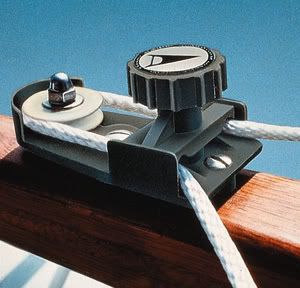
Have you ever been out for a lazy Great Lakes sail and wished you could step below for moment to grab a cold drink or perhaps a pair of sunglasses but you couldn't leave the tiller unattended? Davis Marine makes a product they call a "Tiller Tamer" that might help in such a situation.

The Tiller Tamer is essentially a clamping device for a tiller control line. It is constructed of durable, hard plastic with stainless steel hardware (screw/hex nut). The Tiller Tamer mounts directly on top of the forward end of the tiller handle. If your tiller is made of anything other than wood, you may need to fabricate mounting hardware or forego the Tiller Tamer all together. The device is mounted via two wood screws. The control line (1/4" diameter provided) is then run from the stern corners of the cockpit to the Tiller Tamer. I personally use jam cleats mounted directly in the fiberglass of the cockpit's stern to anchor the control line. You could also use cam cleats or other means. The Tiller Tamer does NOT come with any cleats.

The device works by turning the knob on top of the Tiller Tamer to essentially clamp the control line and thereby hold the tiller in a set position. I've found the clamp to hold very well in most conditions. Davis Marine advertises that the device works in "any weather or wind condition", but I wouldn't trust it in anything more than moderate wind and waves. I also would not recommend leaving the cockpit or tiller completely unattended while the Tiller Tamer is in use. Depending on how well your boat tracks, you may find that even with the Tiller Tamer in use the boat will wander and move off course in a matter of minutes. Small adjustments and a watchful eye make the Tiller Tamer more effective.

If you're looking for a simple and affordable way to occasionally free up your hands while in the cockpit, the Tiller Tamer should do the trick. However, I do not recommend it as a method of true self-steering. The Tiller Tamer can be purchased from many vendors from between $25 and $35, plus the cost of cleats.


Winter's halftime in the Great Lakes


Are we halfway through another winter in the Great Lakes? Close enough by my calendar. As February quickly approaches, spring task lists start to float to the top of a sailor’s brain. I’m sitting here in my office daydreaming about oiling teak handrails, applying bottom paint to my hull, cleaning my sails and a dozen other activities that would seem like chores were it any other time of year. The middle of winter has a strange way of making me appreciate summer. To paraphrase John Denver’s “Relatively Speaking”: The sunshine needs the shadows of the night. Contrast makes it go. And so, summer needs the depth of winter.


Privacy Policy

Privacy Policy for http://www.grealakessailing.blogspot.com

If you require any more information or have any questions about our privacy policy, please feel free to contact us by email at kwaltersmi@yahoo.com.

The privacy of our visitors is of extreme importance to us. This privacy policy document outlines the types of personal information is received and collected by www.sailfarlivefree.com and how it is used. Like many other Web sites, our website makes use of log files. The information inside the log files includes internet protocol ( IP ) addresses, type of browser, Internet Service Provider ( ISP ), date/time stamp, referring/exit pages, and number of clicks to analyze trends, administer the site, track user’s movement around the site, and gather demographic information. IP addresses, and other such information are not linked to any information that is personally identifiable. Greatlakessailing.blogspot.com does use cookies to store information about visitors preferences, record user-specific information on which pages the user access or visit, customize Web page content based on visitors browser type or other information that the visitor sends via their browser. Google, as a third party vendor, uses cookies to serve ads on Greatlakessailing.blogspot.com. Google's use of the DART cookie enables it to serve ads to users based on their visit to Greatlakessailing.blogspot.com and other sites on the Internet. Users may opt out of the use of the DART cookie by visiting the Google ad and content network privacy policy at the following URL - http://www.google.com/privacy_ads.html Some of our advertising partners may use cookies and web beacons on our site. Our advertising partners include Google Adsense and Commission Junction. These third-party ad servers or ad networks use technology for advertisements and links that appear on Greatlakessailing.blogspot.com and send directly to your browsers. They automatically receive your IP address when this occurs. Other technologies ( such as cookies, JavaScript, or Web Beacons ) may also be used by the third-party ad networks to measure the effectiveness of their advertisements and/or to personalize the advertising content that you see. Greatlakessailing.blogspot.com has no access to or control over these cookies that are used by third-party advertisers. You should consult the respective privacy policies of these third-party ad servers for more detailed information on their practices as well as for instructions about how to opt-out of certain practices. www.sailfarlivefree.com's privacy policy does not apply to, and we cannot control the activities of, such other advertisers or web sites. If you wish to disable cookies, you may do so through your individual browser options. More detailed information about cookie management with specific web browsers can be found at the browsers' respective websites.